
Enterprise security leaders have spent years preparing for the unknown exploit. The zero-day vulnerability, the unpatched server, the malicious payload, and the compromised endpoint have shaped board conversations, security budgets, and incident response planning for more than a decade.
Yet many modern breaches no longer begin with a dramatic technical breakthrough. They begin with trust.
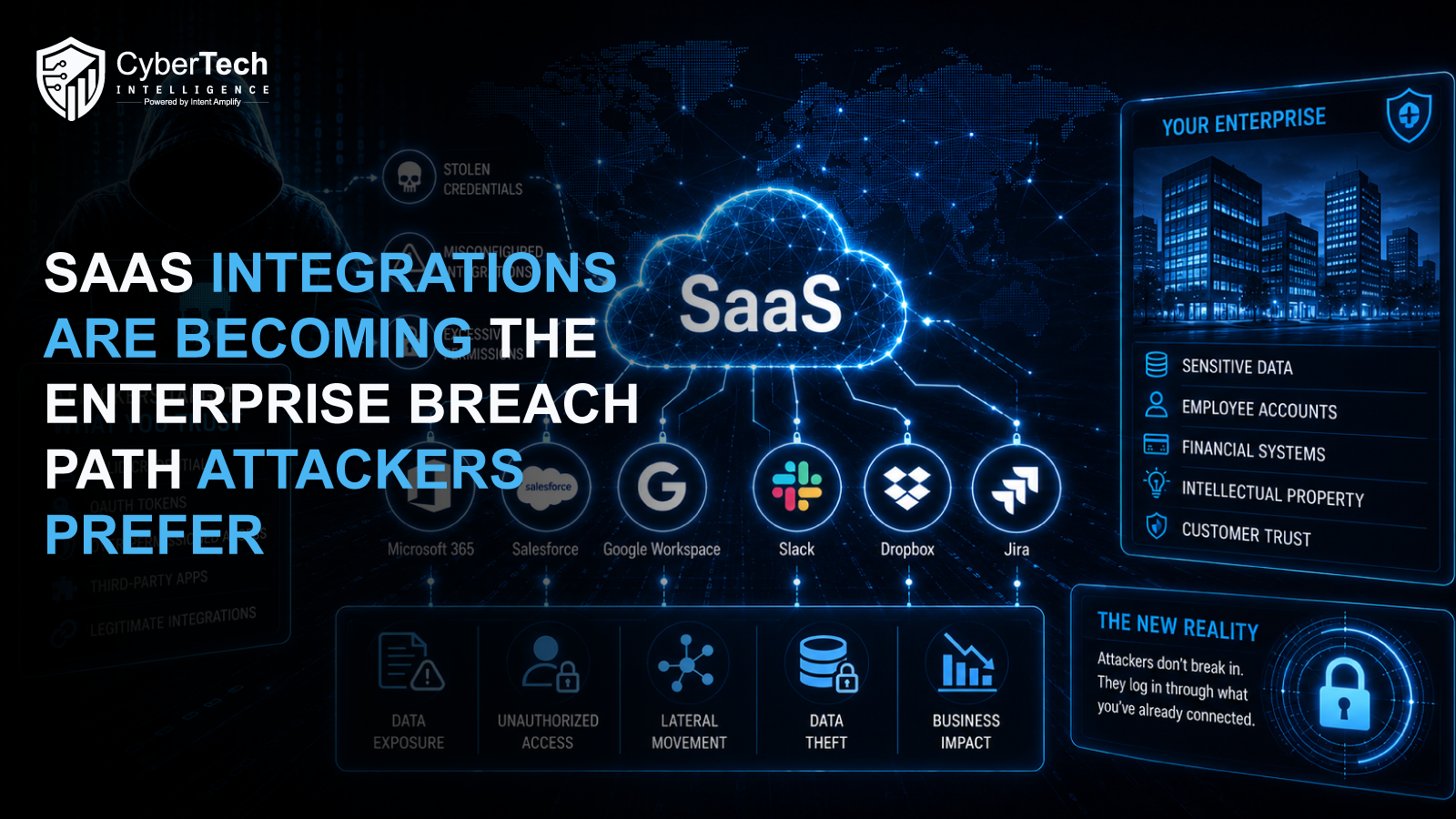
Across today’s cloud-first enterprise, sensitive data moves through Software as a Service (SaaS) platforms, third-party applications, customer relationship management systems, workflow automation tools, artificial intelligence assistants, analytics engines, identity providers, and application programming interfaces. These systems are often connected through OAuth grants, delegated permissions, service accounts, and long-lived tokens. Each connection improves productivity, but each one also expands the attack surface.
That shift matters because adversaries do not always need to break directly into enterprise infrastructure. Increasingly, they can abuse the access that the business has already approved.
Verizon reported that third-party involvement in breaches doubled from 15% to 30% in one year, showing that external parties are no longer peripheral risks in enterprise compromise patterns.1
For chief information security officers, the warning is direct. The next major compromise may not come through the firewall. It may come through an authorized integration that still holds permissions, still has access, and still operates without meaningful review.
The Enterprise Perimeter Has Moved Into the SaaS Layer
The traditional security perimeter was built around infrastructure that the organization owned or directly controlled. Networks, servers, endpoints, and internal applications formed the defensive boundary. That model has weakened as enterprises move more work into cloud platforms and SaaS ecosystems.
The Governance Challenge of SaaS Trust Relationships
Modern business processes rarely operate within a single application. A sales platform may connect to email systems, calendars, customer databases, conversational AI tools, revenue intelligence platforms, and analytics services. Human resources applications often integrate with payroll, identity management, benefits administration, and document management systems. Marketing platforms routinely exchange data with customer databases, enrichment providers, campaign tools, website analytics, and AI-powered services.
These connections are not inherently risky. They are fundamental to modern digital operations. The challenge arises when integrations are treated as implementation tasks rather than ongoing trust relationships.
In many organizations, integrations are approved during deployment, granted broad permissions to accelerate adoption, and then receive little subsequent review. Over time, ownership changes, business requirements evolve, application usage declines, and vendor risk profiles shift. Yet permissions often remain unchanged, access tokens stay active, and integrations continue operating with the same level of trust they received on day one.
The result is a growing layer of unmanaged access embedded throughout the SaaS ecosystem. In practical terms, organizations may continue to trust applications, accounts, and integrations that no longer have an active business owner, a validated business purpose, or an appropriate level of access.
This creates a governance problem as much as a security problem. Trust relationships accumulate faster than they are reviewed, creating visibility gaps that are difficult to identify through traditional security controls.
Attackers recognize this imbalance. An overlooked integration, an unused OAuth grant, a dormant service account, or an excessive permission scope can provide a path into sensitive systems without requiring the compromise of the SaaS platform itself.
The security challenge is therefore not simply determining which integrations exist. It is continuously validating that every trusted connection remains necessary, appropriately scoped, actively owned, and aligned with business requirements.
Trusted Access Is Harder to Detect Than Forced Entry
Traditional monitoring is often stronger at identifying suspicious entry than suspicious use of legitimate access. Failed login attempts, malware execution, endpoint anomalies, privilege escalation, and unusual network traffic are familiar signals for security operations teams.
SaaS integration abuse behaves differently. When an attacker uses a valid OAuth token or a compromised application connector, the activity may appear to come from a known tool. The authentication flow may succeed. Multi-factor authentication may not be triggered. The application may already have permission to read, export, or synchronize sensitive data.
In other words, the attacker is not always forcing entry. They are using an approved route.
That creates an uncomfortable detection gap. Security teams must move beyond asking whether access was authenticated. They also need to ask whether the activity still makes business sense. Should this application export this volume of records? Should this connector have write permissions? Should this service account remain active? Should an application used by one business unit reach sensitive data across another?
IBM reported that supply chain compromise costs an average of USD 4.91 million and takes 267 days to identify and contain, making it one of the costliest and longest-running breach vectors in its 2025 findings.2
Long detection timelines are not only a technology problem. They also reflect a governance issue. If an organization does not maintain a clear inventory of connected applications and delegated access paths, it cannot quickly determine which relationships are normal, stale, excessive, or compromised.
Shadow SaaS Is Expanding the Governance Gap
The SaaS risk problem is not limited to formally approved vendors. It is also growing through decentralized technology adoption.
Business teams adopt tools to solve immediate problems. Employees connect applications to email, cloud storage, calendars, customer platforms, or collaboration systems because the process is fast and convenient. Departments may purchase software directly or activate free tools without routing every integration through central IT or security review.
This behavior is not always careless. It reflects how modern work happens. Teams need faster reporting, better automation, quicker customer engagement, and more flexible collaboration. The issue is that security governance often moves more slowly than adoption.
That projection should concern every security leader because unknown applications create unknown authorization pathways. A security team cannot revoke a token that it does not know exists. It cannot assess excessive permissions on an application it has never reviewed. It cannot monitor suspicious API activity from a connector that was never added to the enterprise inventory.
The problem grows as artificial intelligence tools enter daily workflows. These systems may connect to documents, meeting notes, customer records, communication platforms, and operational data so they can summarize, automate, generate, and recommend. The productivity value is real, but so is the access-control challenge.
Accenture reported that 63% of organizations sit in what it calls the “Exposed Zone,” meaning they lack both a cohesive security strategy and the technical foundations needed to manage modern cyber risk.3
For SaaS-heavy enterprises, that exposure is not theoretical. It appears in the gap between what the business uses and what security can actually see.
The Salesloft Drift and Salesforce Incident Shows the New Risk Pattern
The Salesloft Drift and Salesforce incident illustrates how modern SaaS compromise can move through trusted application access rather than direct infrastructure exploitation.
Google Cloud Threat Intelligence Group reported in August 2025 that threat actors targeted Salesforce customer instances through compromised OAuth tokens associated with Salesloft Drift, a third-party application integration.4
That detail matters. The attack path did not require a direct compromise of Salesforce’s own infrastructure. The route came through trusted application access that customers had already authorized. Once those OAuth tokens were abused, attackers could access connected Salesforce environments and extract information from systems that treated the integration as legitimate.
This is why SaaS integration security should be viewed as access security, not only vendor management. A third-party application may function as a bridge into customer records, sales communications, support histories, cloud credentials, and business intelligence. If that bridge is compromised, downstream exposure can be much broader than the original application relationship appears to suggest.
The incident also shows why authentication alone is not enough. Valid tokens can still be dangerous. Approved applications can still be abused. Trusted sessions can still move data in ways that violate business intent.
Over-Permissioned Integrations Increase the Blast Radius
One of the most common failures in SaaS governance is over-permissioning. During deployment, teams often grant broad privileges because it reduces friction and ensures the tool functions properly. After implementation, those privileges may never be narrowed.
This pattern creates permission drift. An application that needed broad access during setup may only require limited access later. A pilot tool may retain production permissions. A service account may survive long after the original owner has left the company. An integration may continue synchronizing data even after the business process has changed.
Attackers benefit from this accumulation. If they compromise a vendor, steal an OAuth token, or abuse a delegated grant, the damage depends on what that access allows. A tightly scoped connector may limit exposure. An over-privileged one can open customer information, company communications, operational details, intellectual property, financial data, or cloud credentials.
As attack volume rises, weakly governed SaaS access becomes a practical advantage for adversaries. It gives them more paths to explore, more identities to abuse, and more trusted connections to exploit.
The solution is not to stop SaaS adoption. That would be unrealistic. The stronger answer is continuous governance. Security teams need to manage API scope, invalidate unused tokens, rotate credentials, assign ownership, and apply least privilege to machine identities with the same discipline they apply to human identities.
Zero Trust Must Include Machine-to-Machine Access
Zero Trust is often discussed in relation to employees, endpoints, networks, and cloud workloads. Yet many organizations still apply weaker controls to SaaS-to-SaaS connections, service accounts, and application identities.
That is a mistake.
NIST states that Zero Trust Architecture supports secure, authorized access to enterprise resources distributed across on-premises and multiple cloud environments, including access for hybrid workforces and partners from anywhere, at any time, and from any device.5
For SaaS integration security, the implication is direct. No connector should retain permanent trust simply because it was once approved. Every application relationship should be evaluated based on current business need, permission scope, data sensitivity, vendor posture, usage behavior, and risk context.
A mature Zero Trust model should answer practical questions. Which third-party applications can access sensitive data? Which OAuth grants are active? Which service accounts have privileged permissions? Which integrations have not been used recently? Which tokens are long-lived? Which connected applications are owned by vendors with elevated risk? Which data exports fall outside normal behavior?
These questions are difficult to answer without tooling, process ownership, and executive support. But they are now central to enterprise resilience.
Conclusion
Enterprise attackers are adapting to the way modern organizations operate. They understand that critical data now moves through SaaS platforms, third-party connectors, AI-enabled applications, automation workflows, and federated identity systems. They also understand that many companies still lack complete visibility into these relationships.
This changes the security conversation. The question is no longer only whether the enterprise can stop malicious entry. It is whether the business can govern trusted access before that trust is abused.
SaaS integrations have become essential to productivity, customer engagement, and operational scale. They have also become part of the enterprise attack surface. Organizations that apply least privilege, monitor application behavior, and extend Zero Trust principles to machine-to-machine access will be better prepared for the next wave of cloud and supply chain threats.
Those who do not may discover that the most damaging breach path was not hidden. It was approved, integrated, and forgotten.
About Cyber Tech Intelligence
CyberTech Intelligence provides research-led cybersecurity insights for security leaders, technology decision-makers, and enterprise teams. Our coverage focuses on emerging threats, cloud security, identity risk, Zero Trust, artificial intelligence security, third-party exposure, compliance, and cyber resilience.
We help organizations understand how fast-changing cyber risks affect business continuity, operational trust, and digital growth.
How Cyber Tech Intelligence Can Help
Cyber Tech Intelligence helps security teams turn complex cyber developments into clear, practical insight. Through threat intelligence coverage, executive analysis, and cybersecurity thought leadership, we support better decision-making around SaaS risk, third-party access, identity security, and cloud governance.
To learn more or connect with our team, visit: Cyber Tech Intelligence
References
- Verizon Business, 2025 Data Breach Investigations Report, 2025
- IBM Security, Cost of a Data Breach Report 2025, 2025
- Accenture, State of Cybersecurity Resilience 2025, 2025
- Google Cloud Threat Intelligence Group, Widespread Data Theft Targets Salesforce Instances via Salesloft Drift, August 2025
- National Institute of Standards and Technology, Implementing a Zero Trust Architecture, SP 1800-35, 2025

Author
CyberTech Intelligence Research Desk
Author